
Patented TIRTAN Vortex Technology
A Different Approach to Enriching Water and Beverages with Molecular Hydrogen
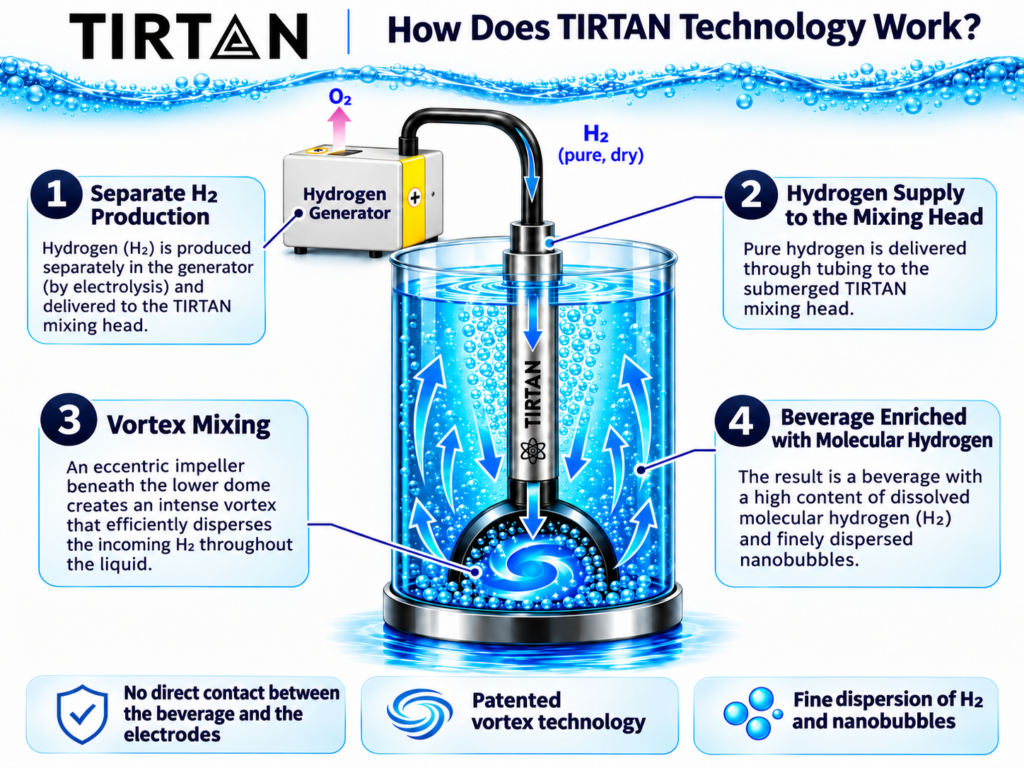
TIRTAN technology offers an original method of enriching water and other suitable beverages with molecular hydrogen (H₂). Unlike devices that use direct electrolysis of the water being prepared, it is based on separate hydrogen generation followed by vortex-based hydrogen infusion into the liquid.
At the heart of the technology is a specially designed mixing head, where intensive vortex flow promotes contact between molecular hydrogen and the liquid, dispersing it into a fine gas dispersion with extensive nanobubble formation.
An important feature of this design is that the beverage does not come into direct contact with the hydrogen generator’s electrodes, making it possible to enrich suitable beverages other than water.
1. What Makes TIRTAN Technology Different?
Many conventional hydrogen-water devices use electrochemical processes in which hydrogen is generated directly inside the water container.
TIRTAN takes a different approach to enriching liquids with hydrogen.
It separates molecular hydrogen generation from its subsequent introduction into the beverage. Hydrogen infusion itself is performed mechanically by means of a patented vortex system.
This concept rests on three fundamental principles.
Separate Hydrogen Generation
Molecular hydrogen is produced in a separate generator and only then introduced into the beverage as a gas.
No Direct Contact with Electrodes
The beverage does not come into direct contact with the hydrogen generator’s electrodes. This eliminates the possibility of electrode material being released directly into the beverage from immersed electrodes during infusion.
Patented Vortex-Based Hydrogen Infusion
The specially designed mixing head creates intensive vortex flow that promotes contact between molecular hydrogen and the liquid and disperses the gas into a fine dispersion.
The combination of these three principles is the foundation of TIRTAN’s original technology.

Molecular hydrogen is produced separately and then added to the beverage.

The beverage does not come into direct contact with the hydrogen generator’s electrodes.
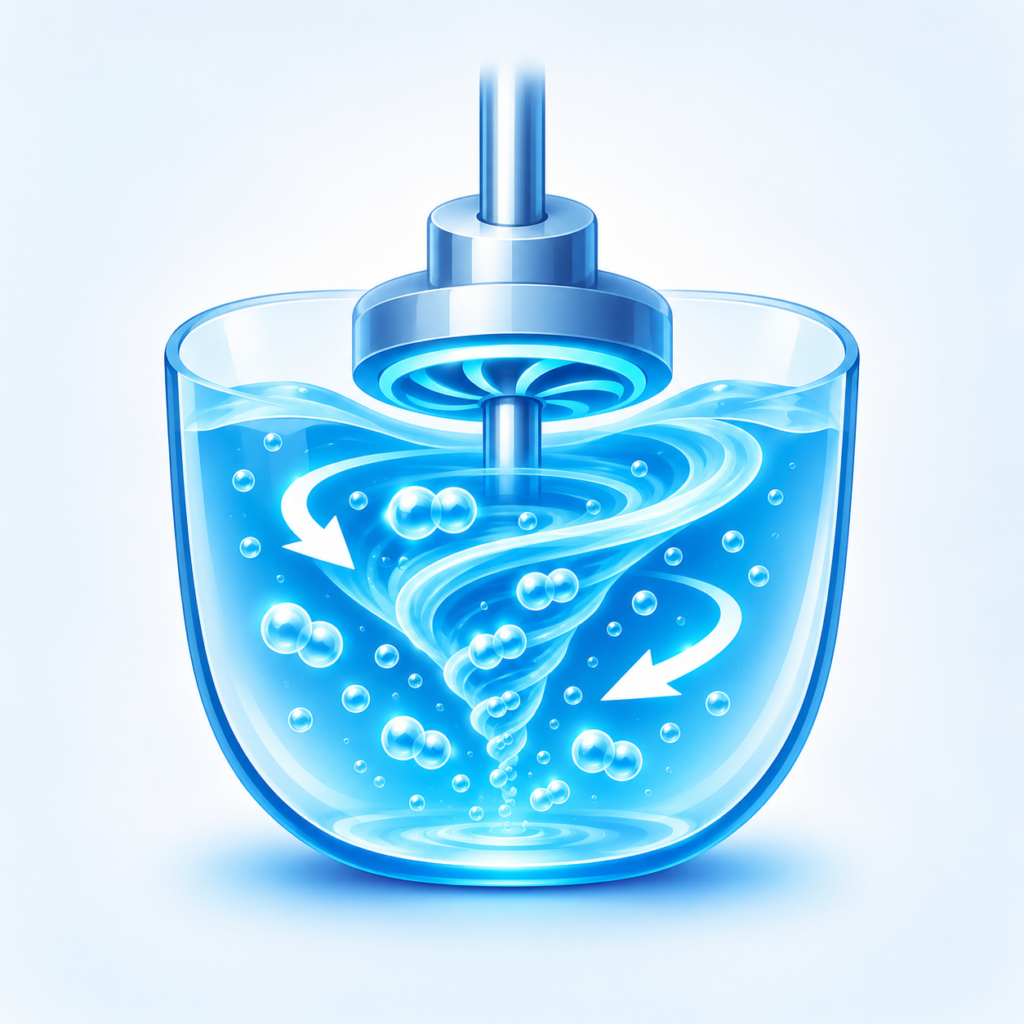
Hydrogen is introduced into the liquid using patented vortex enrichment.
2. How Does TIRTAN Technology Work?
High-Quality Materials and Modern Technology
When developing and designing TIRTAN, we place particular emphasis not only on vortex-infusion performance but also on material quality, suitability for food contact, and the purity of the molecular hydrogen produced.
All plastic components that come into contact with the beverage are made from Tritan™, a material free of bisphenol A (BPA) and bisphenol S (BPS). Metal components that come into contact with the beverage are made from high-quality food-grade stainless steel.
The separate hydrogen generator uses modern PEM (Proton Exchange Membrane) technology, capable of producing molecular hydrogen with a stated purity of 99.9%.

Bez BPA a BPS

Food-grade
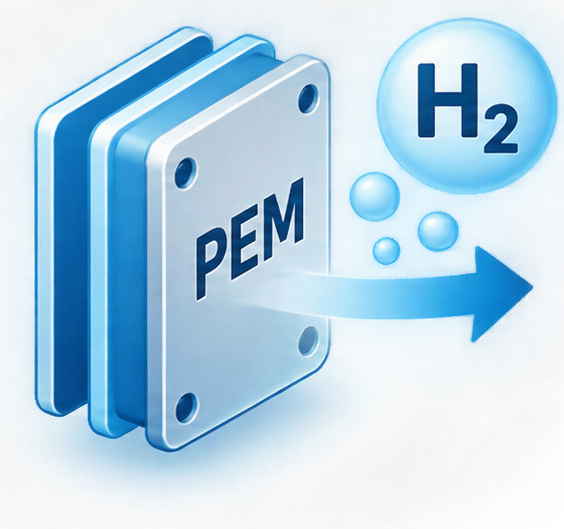
H₂ Purity: 99.9%
The combination of carefully selected materials, separate production of high-purity hydrogen, and patented vortex-based infusion creates a system designed with uncompromising attention to beverage quality.
3. Why Is Separating the Electrodes from the Beverage Important?
One of the key design advantages of TIRTAN is the complete separation of electrochemical hydrogen generation from the beverage being prepared.
During direct water electrolysis, electrochemical reactions take place in a region that is in contact with the liquid being treated.
Depending on the electrolyzer design, materials used, and composition of the water, various electrochemical products may form. Modern electrolyzer systems naturally employ technologies to minimize such risks, but these cannot be ruled out in principle.
TIRTAN, however, adopts a different design principle.
Previously generated molecular hydrogen is introduced into the beverage, rather than passing an electric current through electrodes immersed in the beverage.
This design offers several important characteristics:
- The beverage is not subjected to direct electrolysis.
- The generator electrodes are not immersed in the beverage.
- Hydrogen infusion itself takes place mechanically through vortex mixing.
- Hydrogen generation is structurally separate from its dispersion into the liquid.
Separating the electrodes also makes it possible to enrich other suitable beverages for which direct electrolysis could present technical challenges. This is why we can infuse beverages other than water with hydrogen.
4. Patented Vortex Mixing — The Heart of TIRTAN Technology
The most important component of TIRTAN technology is its specially designed vortex mixing head.
Its design enables intensive liquid flow in the same region where molecular hydrogen is introduced.
Inside the mixing head, a rotating impeller creates complex hydrodynamic conditions involving velocity gradients, shear stresses, and local changes in flow.
These processes influence how the incoming gas is dispersed throughout the liquid.
What Happens During Vortex Mixing?
Intensive Gas–Liquid Contact
Vortex flow increases the intensity of contact between the incoming hydrogen and the surrounding liquid.
Mechanical Gas Dispersion
Hydrodynamic forces can deform larger gas structures and promote their breakup into smaller bubbles.
Formation of Fine Gas Dispersions
The flow characteristics can influence the size distribution of the bubbles formed and their subsequent behavior in the liquid.
Enhanced Hydrogen Transfer into the Liquid Phase
Intensive mixing promotes molecular hydrogen transfer across the gas–water interface. The actual dissolution rate also depends on temperature, hydrogen concentration, pressure, and other parameters.
Why Is Vortex Flow Important?
Vortex mixing provides a way to create intensive hydrodynamic conditions for gas–liquid contact within a relatively compact space.
The properties of the resulting gas dispersion depend on the mixing-head design, impeller speed, the amount of gas supplied, and the properties of the liquid.
The interaction between these parameters is central to understanding TIRTAN technology.
Insert a detailed technical illustration of the actual TIRTAN mixing head here, showing the H₂ inlet, rotating impeller, and direction of liquid flow.
5. Vortex Infusion and Hydrogen Nanobubbles
One of the most fascinating topics associated with TIRTAN is the formation of ultrafine gas structures known as nanobubbles.
Hydrogen nanobubbles are tiny gas structures whose diameters may be on the order of tens to hundreds of nanometers.
At this scale, physical phenomena that are less significant for ordinary visible bubbles become especially important.
These include:
- high Laplace pressure,
- Brownian motion,
- a high surface-area-to-volume ratio,
- electrical properties of the gas–liquid interface,
- possible electrostatic interactions between bubbles.
What Role Might Vortex Technology Play?
Intensive vortex flow creates conditions in which the incoming gas is mechanically dispersed.
One of the key research questions is how these hydrodynamic conditions affect the formation, size distribution, and stability of ultrafine hydrogen bubbles.
Potential relationships between flow intensity and the electrical properties of newly formed gas interfaces also deserve special attention.
This includes research into the electric double layer (EDL), zeta potential, and possible electrokinetic or triboelectric processes.
These mechanisms cannot automatically be regarded as experimentally established properties of a particular device. Their significance must be verified through appropriate physical measurements.
We discuss the physics of hydrogen nanobubbles in greater detail on a separate technical page.
Learn more: Hydrogen Nanobubbles — Formation, Properties and Stability.
6. Hydrogen Concentration and the Importance of Accurate Measurement
Several physical and analytical parameters are used to evaluate beverages enriched with molecular hydrogen.
The most common include the concentration of dissolved molecular hydrogen, expressed in mg/L or ppm, and oxidation–reduction potential (ORP).
Under our usual measurement conditions, water prepared using TIRTAN technology reaches dissolved hydrogen concentrations of approximately 1.3–1.4 mg/L, equivalent to approximately 1.3–1.4 ppm.
At the same time, we observe strongly negative ORP values, typically around −600 to −650 mV, depending on the particular preparation and measurement conditions.
These figures are results of our operational measurements, not universally guaranteed specifications for every beverage or operating condition.
Dissolved Hydrogen Is Not Necessarily the Same as Total Hydrogen
If a dispersed gas phase is present in water alongside dissolved H₂, measuring dissolved hydrogen alone may not describe the total amount of molecular hydrogen in the sample.
A suitable, validated analytical method is required to determine the total hydrogen content.
ORP is also not a direct measure of H₂ concentration and cannot be used to reliably calculate the quantity of molecular hydrogen.
We therefore consider not only the measured values but also the physical form of hydrogen present in the water and the proper interpretation of the results.
Learn more: Methods for Measuring Molecular Hydrogen and Their Limitations.
7. Beyond Water — Vortex Infusion for Other Beverages
A significant practical feature of TIRTAN is its ability to work not only with pure water but also with other suitable beverages.
Because hydrogen infusion itself does not require direct electrolysis of the beverage, the system is not structurally limited to water suitable for electrochemical hydrogen generation.
Vortex technology therefore opens the possibility of enriching certain non-alcoholic beverages with molecular hydrogen.
Why Is This Important?
Different beverages have different chemical compositions, viscosities, surface tensions, and dissolved-solute contents.
These properties can affect gas dissolution, bubble formation, and the behavior of the resulting dispersion.
Vortex infusion enables these processes to be investigated in liquids with properties different from those of pure water.
The suitability of each beverage must nevertheless be evaluated according to its composition, hygiene requirements, and the operating conditions of the device.
TIRTAN thus expands the possibilities of working with molecular hydrogen beyond conventional hydrogen-rich water.
Insert the illustrations of suitable beverages that we previously prepared together.
8. Patent Protection of TIRTAN Technology
The original TIRTAN design is protected by patents granted in the United States, China, Russia, and Europe, with patent proceedings underway in other countries.
These patents represent an important milestone in the development of TIRTAN technology.
9. Scientific Research and Further Technology Development
The development of TIRTAN is closely connected with research into molecular hydrogen and its properties.
We have long collaborated with specialist research institutions on projects involving molecular hydrogen, its behavior in liquid environments, and its potential applications.
These collaborations include research activities with institutes of the Slovak Academy of Sciences (SAS) in Bratislava and Palacký University Olomouc (UP).
Hydrogen Nanobubble Research
Research into hydrogen nanobubbles formed using TIRTAN vortex technology is currently underway in collaboration with a research institute of the Slovak Academy of Sciences in Bratislava.
Particular attention is being paid to characterizing the resulting nanoscale dispersions and gaining a deeper understanding of the physical processes that affect their formation and properties.
The aim is to obtain new experimental findings that will help explain the processes taking place during vortex-based molecular hydrogen infusion.
Our objective is to connect in-house technological development with independent scientific research and to progressively verify the properties of TIRTAN using objective experimental methods.
We will publish research findings as they undergo sufficient experimental verification.
Learn more: Scientific Research and Collaboration.
10. Key Advantages of TIRTAN Technology
Patented TIRTAN vortex technology combines several design and technological features in a single system.
Separate Molecular Hydrogen Generation
Hydrogen is produced separately and then introduced into the beverage as a gas.
No Direct Electrode Contact with the Beverage
The beverage is not directly electrolyzed and does not come into contact with the hydrogen generator’s electrodes.
Patented Vortex-Based Hydrogen Infusion
A specially designed mixing head creates hydrodynamic conditions that promote intensive gas–liquid contact and dispersion.
Ability to Enrich a Range of Suitable Beverages
Separating hydrogen generation from infusion expands the technology’s potential applications.
Research into Fine Gas Dispersions
Vortex infusion is an interesting technological approach for studying the formation and behavior of ultrafine hydrogen bubbles.
Connecting Technology Development with Scientific Research
Research activities with scientific institutions contribute to a deeper understanding of the physical properties of hydrogen dispersions and the further development of the technology.
11. Frequently Asked Questions About TIRTAN Technology
Is TIRTAN a Conventional Electrolyzer?
No. TIRTAN uses molecular hydrogen produced in a separate generator, while infusion into the beverage takes place mechanically through the patented vortex system.
Does the Beverage Come into Contact with Electrodes?
No. The electrodes of the hydrogen generator are structurally separated from the beverage being prepared.
What Is the Role of the Vortex Mixing Head?
It creates intensive flow that promotes contact between the incoming hydrogen and the liquid, dispersing the gas into a fine dispersion.
Can TIRTAN Enrich Beverages Other Than Water?
Yes. The system’s design also allows other suitable beverages to be used. Their suitability depends on composition and operating conditions.
Does TIRTAN Produce Hydrogen Nanobubbles?
The characterization of ultrafine gas dispersions produced with TIRTAN is the subject of ongoing research. Initial findings suggest particularly high nanobubble-generation efficiency compared with other technologies, while the specific parameters and their reproducibility continue to be investigated using appropriate analytical methods.
Is TIRTAN Technology Patented?
Yes. The technology is protected by U.S. Patent No. 12,268,996 B2, granted on May 13, 2025, as well as patents in other countries.
12. TIRTAN — Combining Patented Technology and Scientific Research
TIRTAN represents an original approach to enriching water and other suitable beverages with molecular hydrogen.
Its distinguishing feature is not simply the generation of hydrogen itself, but the patented method of introducing it into a liquid through intensive vortex mixing.
Separate hydrogen generation, the specific mixing-head design, and the ability to produce fine gas dispersions are key characteristics of the technology.
TIRTAN combines technical originality, practical applications, and ongoing scientific research to further advance the use of molecular hydrogen in liquid media.
Would You Like to Learn More About Molecular Hydrogen?
You can find more detailed information in our technical articles:
- Hydrogen Nanobubbles — Formation, Properties and Stability
- Measuring Molecular Hydrogen and Its Limitations
- Molecular Hydrogen, Oxidative Stress and Nrf2
- Scientific Research and Collaboration