
Hydrogen Nanobubbles
An invisible world with remarkable physical properties
How can tiny gas bubbles change our understanding of molecular hydrogen in water?
Imagine a bubble so small that its diameter is a thousand times smaller than the thickness of a human hair. A bubble that, unlike the ordinary bubbles in sparkling water, does not rise quickly to the surface. Electrical phenomena can manifest on its surface, and according to the classical laws of physics, a surprisingly high pressure can prevail inside it.
Such objects are called nanobubbles, and they are used by our TIRTAN technology.
Although individual nanobubbles are invisible to the naked eye, their properties can significantly influence the behaviour of gases dispersed in liquids. Nanobubbles containing molecular hydrogen H₂ attract particular attention in scientific research.
Their formation, stability, surface electric charge and interaction with the surrounding water represent a fascinating field at the intersection of hydrodynamics, physical chemistry and nanotechnology.
1. What are hydrogen nanobubbles?
A nanobubble is an extremely small gas bubble surrounded by liquid. In the case of hydrogen nanobubbles, its gaseous content is molecular hydrogen H₂.
It is important to distinguish between two different forms in which hydrogen is present in water:
Dissolved molecular hydrogen H₂(aq) consists of individual hydrogen molecules dispersed in the liquid phase.
Hydrogen nanobubbles represent a separate gas phase, separated from the surrounding water by an interface.
According to the international standard ISO 20480-1, ultrafine bubbles are defined as gas bubbles with a diameter of less than 1 micrometre, i.e. 1,000 nanometres. In everyday technical communication, they are also referred to as nanobubbles.
How small are nanobubbles really?
| Bubble type | Diameter |
| Ordinary visible bubbles | hundreds of μm to millimetres |
| Microbubbles | 1–100 μm |
| Ultrafine bubbles – nanobubbles | less than 1,000 nm |
| Very small nanobubbles | e.g. 50 nm |
For comparison: a human hair has a diameter of approximately 50,000 to 100,000 nanometres. A hydrogen nanobubble with a diameter of 50 nm is therefore roughly one thousand to two thousand times smaller than the thickness of a human hair. Yet it can contain tens of thousands of molecules of molecular hydrogen.
A nanobubble is not a single hydrogen molecule. It is a tiny gas structure with its own volume, surface and physical properties.
2. Why don’t nanobubbles rise quickly to the surface?
Everyone is familiar with the behaviour of bubbles in sparkling water. They form in the liquid, rise towards the surface and eventually disappear. They rise because of the buoyant force acting on a gas whose density is lower than that of the surrounding liquid.
With nanobubbles, however, the situation changes fundamentally. The buoyant force depends on the volume of the bubble, i.e. on the cube of its radius. If the diameter of a bubble decreases tenfold, its volume and buoyancy decrease approximately a thousandfold, all other conditions being equal. Gravitational rise of nanobubbles is therefore extremely slow.
Brownian motion
At the same time, another physical phenomenon comes into play – Brownian motion. Water molecules are in constant chaotic motion. Their thermal motion causes random movements of very small objects dispersed in the liquid.
For ordinary large bubbles, this effect is negligible. For nanobubbles, however, it can be significant. While a large bubble rises predominantly upwards, a nanobubble may move irregularly in various directions.
For example, for an ideally spherical bubble with a diameter of 100 nm, the Stokes model gives a gravitational rise velocity in water of only a few to a few tens of micrometres per hour. On small time and length scales, Brownian motion can therefore clearly dominate over gravitational displacement.
This helps explain why ultrafine bubbles can remain dispersed throughout the volume of the liquid.
However, two questions need to be distinguished: why a nanobubble does not quickly float to the surface, and why the gas inside it does not quickly dissolve.
The second question is one of the most interesting problems in the current physics of nanobubbles.
3. Laplace pressure: why can there be more than 50 atmospheres inside a nanobubble?
One of the most remarkable physical properties of nanobubbles is the pressure of the gas inside them. Every interface between a gas and a liquid has a certain surface tension.
Surface tension tends to minimise the area of the interface. In a spherical bubble, it therefore creates a pressure difference between the inside of the bubble and the surrounding liquid. This difference is described by the Young–Laplace equation: Δp = 2γ / r
- Δp – pressure difference between the inside of the bubble and the surrounding water
- γ – surface tension of water
- r – bubble radius
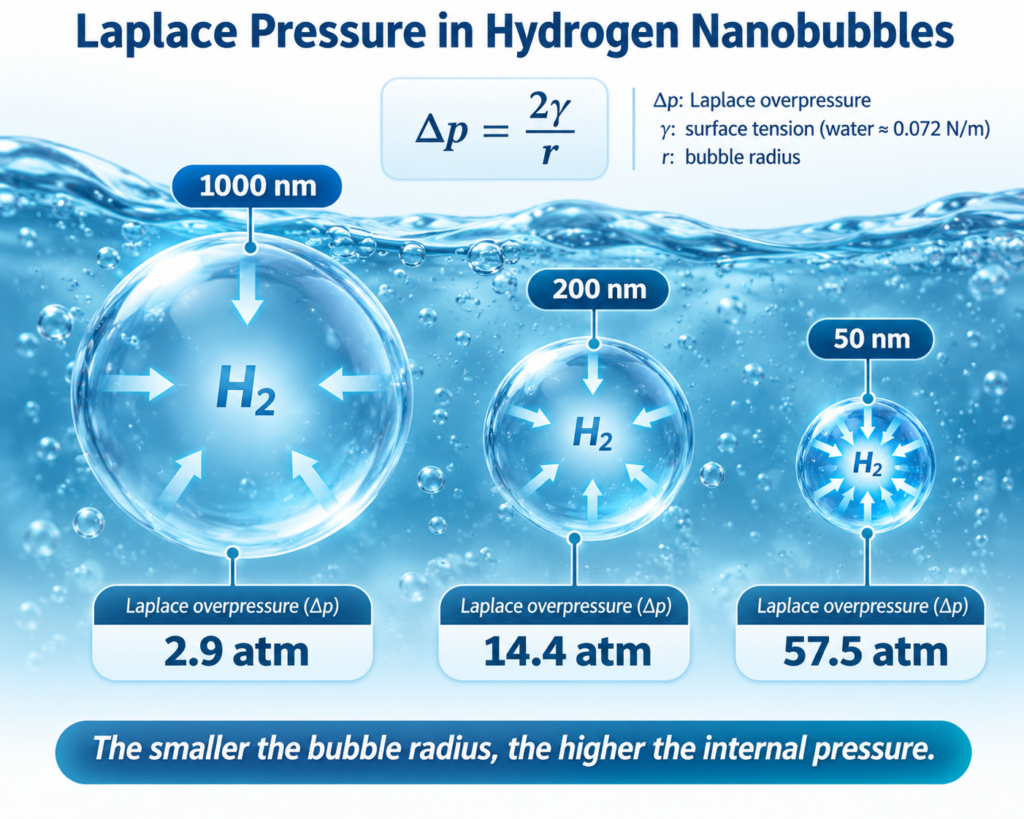
The smaller the radius of the bubble, the greater its Laplace overpressure.
For pure water at a temperature of approximately 20 °C and a surface tension of 72.8 mN/m, we obtain the following values:
| Bubble diameter | Laplace overpressure |
| 1,000 nm | 2.9 atm |
| 200 nm | 14.4 atm |
| 100 nm | 28.7 atm |
| 50 nm | 57.5 atm |
For a bubble with a diameter of just 50 nm, classical physics therefore predicts an overpressure of approximately 57.5 atmospheres. If the surrounding water is at atmospheric pressure, the calculated absolute pressure inside the bubble is approximately 58.5 atmospheres.
This is a theoretical calculation assuming a spherical bubble shape, constant surface tension and mechanical equilibrium of the interface. The actual properties of nanometre-scale gas interfaces may be more complex.
The high-pressure paradox
It is precisely the high Laplace pressure that presents an interesting physical paradox. The smaller the bubble, the higher the gas pressure inside it. Higher pressure, in turn, increases the tendency of the gas to pass into the surrounding liquid.
According to classical diffusion models, very small gas bubbles in undersaturated water should therefore dissolve rapidly. Under certain conditions, however, experimental studies observe nanoscale objects interpreted as gas nanobubbles that persist much longer than simple models predict.
Explaining this stability is one of the major open questions of current research.
4. How many hydrogen molecules does a single nanobubble contain?
Despite its tiny dimensions, a nanobubble can contain a surprisingly large number of gas molecules. The number of molecules can be estimated using the ideal gas equation of state:
pV = NkT
- p – absolute gas pressure
- V – bubble volume
- N – number of molecules
- k – Boltzmann constant
- T – absolute temperature
Consider, for example, a spherical hydrogen nanobubble with a diameter of 50 nm. Its radius is 25 nm and its volume is approximately:
V = 6.54 × 10⁻²³ m³
At a temperature of 20 °C and a calculated absolute pressure of approximately 58.5 atmospheres, we obtain:
N ≈ 96,000 H₂ molecules
According to this idealised model, such a small gas structure can therefore contain almost one hundred thousand molecules of molecular hydrogen. Larger bubbles can contain considerably more molecules.
For example, a bubble with a diameter of 200 nm has 64 times the volume of a bubble with a diameter of 50 nm. Its Laplace pressure, however, is approximately four times lower. The number of molecules therefore does not grow with the bubble volume alone, but also depends on its internal pressure.
Does a larger number of nanobubbles automatically mean more hydrogen?
No. The total amount of hydrogen in a dispersion depends on the number of bubbles, their size distribution, the gas pressure inside them and also the concentration of hydrogen dissolved in the water itself.
A large number of very small bubbles may therefore not contain more gas than a smaller number of larger bubbles. To assess a hydrogen dispersion correctly, it is important to know not only the number of bubbles, but also their size and other physical parameters.
5. The electric double layer (EDL) – the invisible electrical shell of nanobubbles
Another remarkable property of nanobubbles is their surface electrical behaviour. The hydrogen molecule H₂ itself is electrically neutral.
The surface of a gas bubble surrounded by water, however, can exhibit electrical properties resulting from the arrangement of water molecules and ions near the interface.
A so-called electric double layer – EDL – can form at the gas–liquid interface. Its structure comprises the spatial distribution of electric charge near the surface and the corresponding arrangement of ions in the surrounding liquid.
A negative zeta potential has been found in many experimentally studied dispersions of ultrafine bubbles.
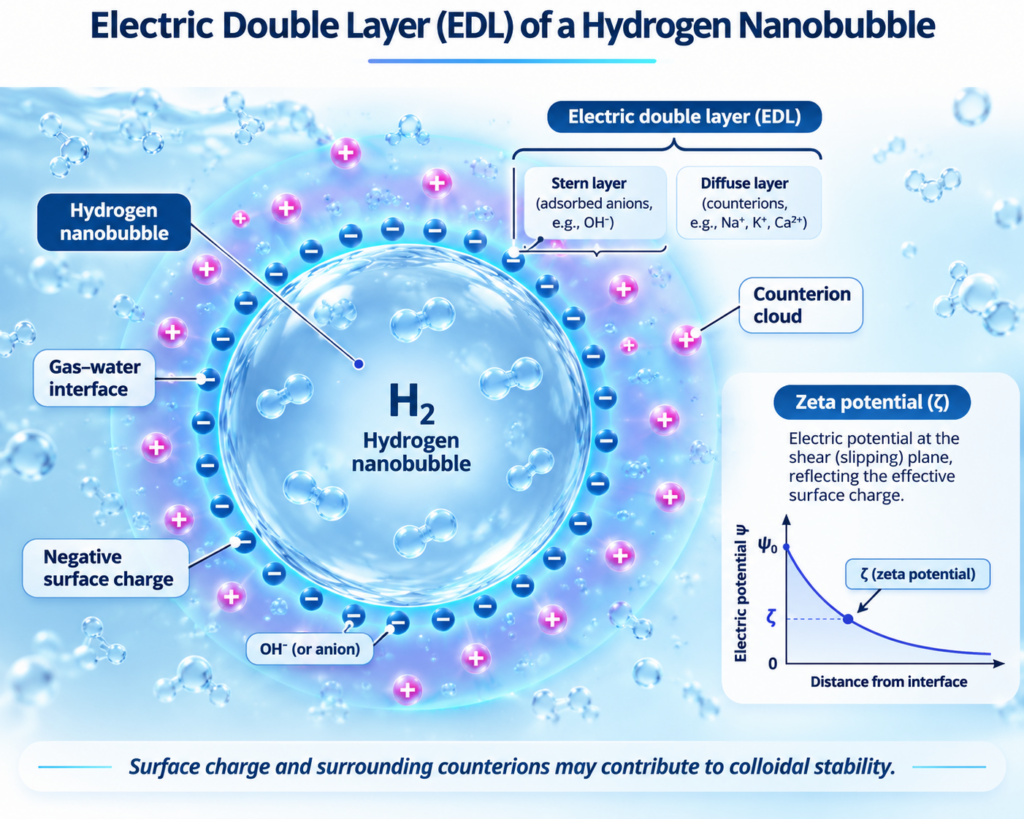
Why can a nanobubble have a negative surface potential?
Adsorption of hydroxide ions OH⁻
Under certain conditions, hydroxide ions may preferentially occupy the interfacial region between water and gas.
Adsorption of other anions
Other negatively charged ions present in the water can also influence the electrical properties of the interface.
Orientation of water molecules
Water molecules have an electric dipole. Their orientation near the interface can contribute to its electrical properties.
Presence of trace substances
Even minute amounts of ionic or surface-active substances can affect the electrical behaviour of nanobubbles.
The exact origin of the surface electric potential has not yet been clearly explained in all cases. What matters is that the electrical properties of the interface do not mean that the hydrogen molecules themselves acquire an electric charge.
Hydrogen H₂ remains electrically neutral. Electrical phenomena take place mainly at the interface between the gas and the water.
6. Zeta potential and mutual repulsion of nanobubbles
The zeta potential, denoted by the Greek letter ζ, is the electric potential at the hydrodynamic slipping plane around a dispersed object. It is not identical to the electric potential directly at the bubble surface, but it provides important information about its electrokinetic behaviour.
If two nanobubbles have a similarly negative zeta potential, electrostatic repulsion can arise between them. Such repulsive interactions can limit the approach of the bubbles and their merging into larger structures. The stabilisation of many colloidal dispersions is based on similar principles.
What influences the zeta potential?
- pH of the water
- concentration and type of dissolved ions
- electrical conductivity of the water
- presence of surface-active substances
- chemical and physical properties of the interface
- temperature and conditions under which the dispersion is prepared
The zeta potential is therefore not a fixed property of hydrogen itself. It results from the interactions between the bubble and the environment in which it is located.
Can electric charge stabilise nanobubbles?
Electrostatic repulsion can help limit the coalescence of nanobubbles into larger bubbles. This can contribute to the colloidal stability of a fine dispersion.
However, it is necessary to distinguish between stability against bubble coalescence and stability against gas dissolution. Electrical repulsion between bubbles does not in itself prove that the gas inside individual nanobubbles cannot diffuse into the surrounding water. A complete explanation of the long-term stability of bulk nanobubbles therefore remains a subject of scientific research.
7. Why can nanobubbles persist longer than classical physics predicts?
One of the most debated properties of bulk nanobubbles is their seemingly unusual stability. Classical diffusion models predict that small gas bubbles in an undersaturated liquid will quickly disappear by dissolving. Nevertheless, there are experimental studies describing long-lasting nanoscale gas dispersions.
Several physical mechanisms have been proposed to explain this behaviour.
Electrostatic and interfacial effects
The surface electric potential and the structure of the interface can influence the energy conditions under which a nanobubble exists.
Local supersaturation of the liquid with gas
If the liquid is sufficiently saturated or supersaturated with gas, the conditions for its transfer across the bubble surface can change substantially.
Changes in effective surface tension
Some theoretical models assume that at nanometre dimensions the effective surface tension of the interface need not be the same as the value used for ordinary macroscopic liquids.
Thermal fluctuations of the interface
Research published in Physical Review Letters in 2024 proposed a model in which thermal fluctuations of the interface reduce the effective surface tension and, under certain conditions, may contribute to the stabilisation of nanobubbles.
Influence of impurities and molecules adsorbed at the interface
Trace impurities, ions or organic molecules can significantly alter the behaviour of the interface between water and gas.
Current science does not yet have a single universally accepted explanation for the long-term stability of all bulk nanobubbles.
The search for this explanation is one of the most interesting areas of current nanobubble research.
8. Why is the size of nanobubbles so important?
As bubbles get smaller, their surface-to-volume ratio changes dramatically. For a spherical bubble:
A / V = 3 / r
Where A is the surface area, V the volume and r the radius. The smaller the radius of the bubble, the larger the interfacial area per unit of its volume.
For comparison: for the same total volume of gas, bubbles with a diameter of 50 nm have twenty times the total interfacial area of bubbles with a diameter of 1,000 nm. This result applies when comparing sets of equally sized bubbles containing the same total volume of gas.
Why is a large surface area important?
The transfer of gas molecules between the bubble and the liquid takes place precisely across their shared interface. A large interfacial area can therefore significantly influence the rate of gas transfer.
The resulting transport, however, also depends on the concentration of dissolved gas, pressure, temperature and other conditions. A larger interfacial area alone therefore does not guarantee longer retention of hydrogen or a higher total amount of it. From a physical point of view, however, it is one of the key characteristics of fine gas dispersions.
9. How can nanobubbles form in intense vortex flow?
The formation of very small bubbles is related to processes occurring when gas comes into contact with a flowing liquid. Intense mechanical mixing creates velocity gradients, shear stresses and complex turbulent structures.
When gas is fed into such a flow, larger gas structures can undergo deformation, break-up and other processes leading to the formation of a fine dispersion. The resulting bubble size distribution is influenced by a number of factors:
- design and geometry of the mixing chamber
- rotational speed of the mixing element
- intensity of the vortex flow
- local velocity and pressure conditions
- amount of gas supplied
- surface tension and other properties of the liquid
In some hydrodynamic systems, cavitation may also play a role, in which cavities form and collapse in the liquid. However, cavitation is not an automatic consequence of every intense vortex flow, and corresponding experimental data are needed to confirm it.
For the production of hydrogen dispersions, it is particularly important to understand how the specific character of the flow affects gas dispersion and the resulting bubble size distribution.
10. Can vortex flow influence the electric charge of nanobubbles?
In addition to the mechanical dispersion of gas itself, electrical phenomena arising during intense liquid flow are another interesting area. Electrokinetic and contact electrification processes can occur at interfaces between different materials and phases.
In connection with hydrogen nanobubbles, the question therefore arises whether the character of the flow can influence the electrical properties of the interface being formed. This concerns in particular possible changes in:
- the arrangement of ions near the bubble surface
- the electrokinetic potential
- the structure of the electric double layer
- interactions between individual bubbles
One research hypothesis is that specific hydrodynamic conditions influence the surface electrical state of the gas dispersions being formed. In this context, possible triboelectric processes are also worth investigating.
Whether and to what extent a particular vortex flow actually increases the surface electric charge of hydrogen nanobubbles, however, remains to be demonstrated experimentally.
Such research must also take into account the influence of pH, ionic composition and electrical conductivity of the water.
11. TIRTAN – patented vortex technology for infusing molecular hydrogen
Intensive research into the hydrogen nanobubbles produced using the patented TIRTAN vortex technology is currently under way in cooperation with a specialised department of the Slovak Academy of Sciences (SAV) in Bratislava.
TIRTAN technology uses an original design based on controlled mechanical mixing of molecular hydrogen with a liquid. Molecular hydrogen is fed into a special mixing head in which a rotating mixing element generates intense flow.
The resulting hydrodynamic conditions promote contact between the gas and the liquid and its dispersion. A characteristic design feature of TIRTAN is the separation of hydrogen production from its subsequent mixing with the beverage.
The electrodes of the hydrogen generator do not come into direct contact with the beverage being prepared.
Hydrogen is generated separately and then fed as a gas into the mixing chamber. This arrangement makes it possible to infuse water and other suitable beverages without the need for their direct electrolysis.
TIRTAN technology is protected by US patent US 12,268,996 B2 and in other countries.
Vortex flow and the formation of fine gas dispersions
From a physical point of view, the most interesting aspect is the design of the mixing head, which makes it possible to create intense flow in a space into which molecular hydrogen is simultaneously supplied.
The relationship between the geometry of the mixing element, the character of the flow and the formation of fine gas structures is an important subject of further research. Key to understanding the resulting dispersion are, above all, the bubble size distribution, their number, stability and electrical properties.
Experimental characterisation of these parameters can help clarify how specific vortex mixing conditions influence the behaviour of molecular hydrogen in water.
12. What do we know about hydrogen nanobubbles and what remains an open question?
Research into hydrogen nanobubbles is developing rapidly, but some fundamental physical questions still await a full explanation.
What is well supported by physical principles?
- According to the Young–Laplace equation, small bubbles exhibit a higher pressure difference between their interior and their surroundings.
- As bubble size decreases, its surface-to-volume ratio increases.
- Gravitational rise of very small bubbles is extremely slow.
- Brownian motion significantly affects the behaviour of nanoscale objects.
- The interface between gas and water can exhibit electrical properties and a zeta potential.
What is still the subject of research?
- The exact mechanisms of the long-term stability of bulk nanobubbles.
- The role of the electric double layer in stabilising them against dissolution.
- The influence of interfacial dynamics on effective surface tension.
- The relationship between hydrodynamic conditions and the formation of ultrafine bubbles.
- The possible influence of intense vortex flow on surface electrical properties.
- The behaviour of hydrogen nanobubbles in different types of water and beverages.
It is the combination of experimental physics, hydrodynamics and modern analytical methods that can gradually provide answers to these questions.
13. Research into hydrogen nanobubbles of TIRTAN technology
Intensive research into the hydrogen nanobubbles produced using the patented TIRTAN vortex technology is currently under way in cooperation with a specialised department of the Slovak Academy of Sciences (SAV) in Bratislava.
The research focuses on characterising the nanobubbles formed and gaining a deeper understanding of the physical processes that influence their formation and properties.
The findings may contribute not only to the further development of TIRTAN technology, but also to a better understanding of the behaviour of molecular hydrogen in a liquid environment.
We will publish the research results gradually, once they have been thoroughly verified experimentally.
Literature and scientific sources
1. ISO 20480-1:2017. Fine bubble technology – General principles for usage and measurement of fine bubbles – Part 1: Terminology.
2. Chen, C., Gao, Y., Zhang, X. (2025). The Existence and Stability Mechanism of Bulk Nanobubbles: A Review. Nanomaterials, 15(4), 314. DOI: https://doi.org/10.3390/nano15040314
3. Chen, Y., Hu, Y., Wang, B., Chu, X., Zhang, L.-W. (2024). Interfacial Thermal Fluctuations Stabilize Bulk Nanobubbles. Physical Review Letters, 133, 104001. DOI: https://doi.org/10.1103/PhysRevLett.133.104001
4. From Paradox to Practice: A Review on Production Strategies, Stability Mechanisms, and Theoretical Insights of Bulk Nanobubbles (2026). Industrial & Engineering Chemistry Research, 65(13), 6725–6763. DOI: https://doi.org/10.1021/acs.iecr.5c05370
Note: The theoretical calculations presented illustrate general physical principles and do not represent declared measured parameters of the TIRTAN device.
- 1. What are hydrogen nanobubbles?
- 2. Why don't nanobubbles rise quickly to the surface?
- 3. Laplace pressure: why can there be more than 50 atmospheres inside a nanobubble?
- 4. How many hydrogen molecules does a single nanobubble contain?
- 5. The electric double layer (EDL) – the invisible electrical shell of nanobubbles
- 6. Zeta potential and mutual repulsion of nanobubbles
- 7. Why can nanobubbles persist longer than classical physics predicts?
- 8. Why is the size of nanobubbles so important?
- 9. How can nanobubbles form in intense vortex flow?
- 10. Can vortex flow influence the electric charge of nanobubbles?
- 11. TIRTAN – patented vortex technology for infusing molecular hydrogen
- 12. What do we know about hydrogen nanobubbles and what remains an open question?
- 13. Research into hydrogen nanobubbles of TIRTAN technology